


Designing
The design of this project is a result of the advancing of the research - about Latin American Indigenous Architecture - and of an answer to the needings of the city.
FIRST TRY
I realised that the palimpsests were always present at every stage of my development. I talked about it with the brainstorming board, it came back with the dialectic, and I was almost doing one, by modifying the building, when I was doing this montage.
Also, I’ve realised that the colours where pretty similar in my two first presentations, so I rather want to use those colours during the project. It is always interesting but pretty delicate to take this bias in an architecture project, and the way we approach it gives me enough liberties to dare to.
Also, those two things (colours and palimpsests) are clues and important points of Latin American Indigenous Architecture.
Regarding on the needing of the city, I’ve been reading the research on the website and I’ve seen that, obviously, the conventillos are a non-neglectable problem. They do not always get legal water supply and same for the electricity so, residents have to illegally tap into the electricity grid.
Also, Buenos Aires has below 2msq of green space per person.
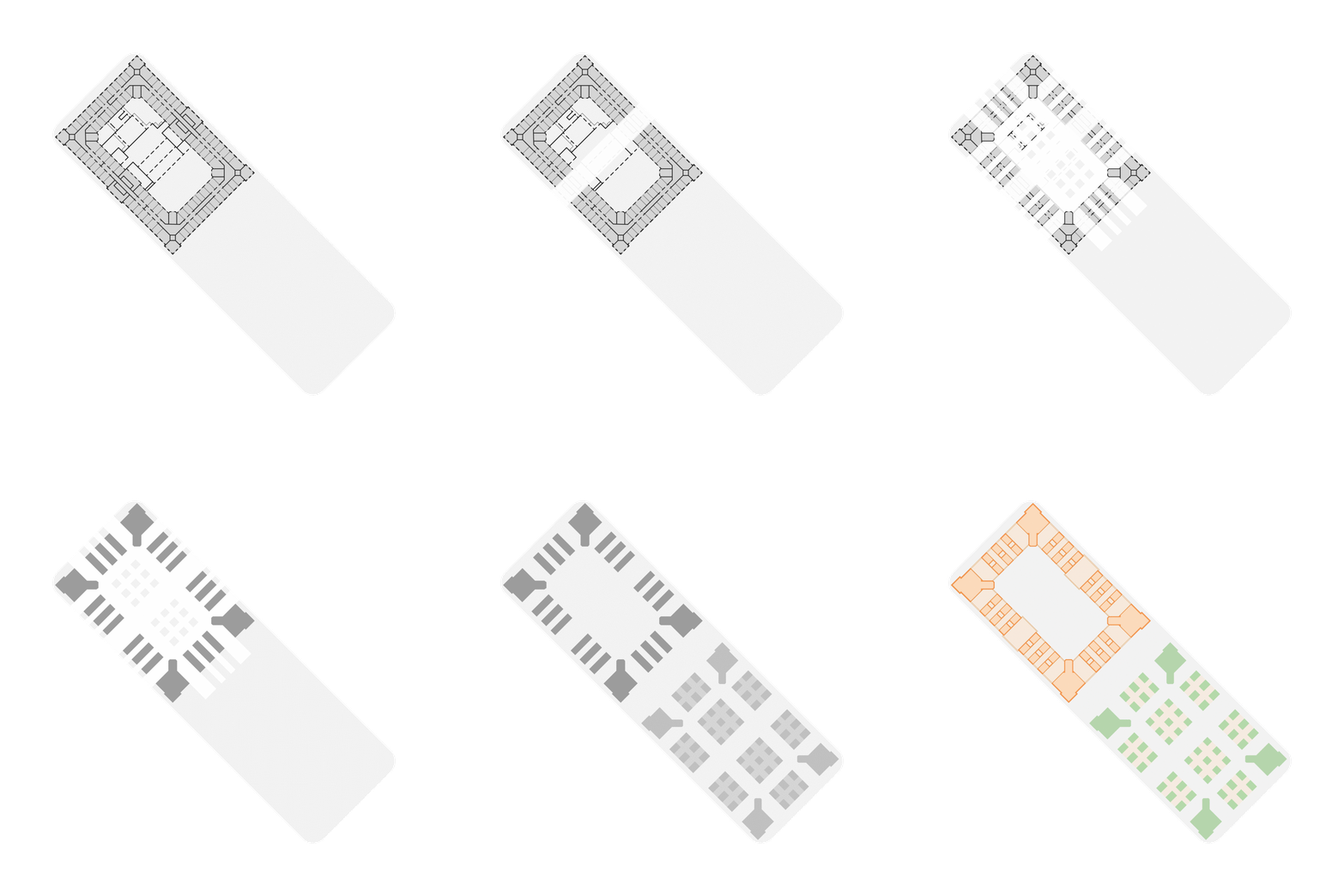
So the main idea is to do a building which serves to people in a social way and which could offer some possibilities needed in the city, by doing a testimony to the Argentinean culture and to this ruin, with a garden allowing a pause or at least a public place.


1First collage

2Jardin de la Ballue



PURSUE OF IDEAS
After having struggled for a long time with my research whithout which I could not have a precise idea of a program, I decided to translate the Indigenous culture, history, way of living and claims in an architecture of experience, if I may call, in the likeness of the Jewish Museum of Berlin, by Daniel Libeskind (1993-98).
After many feedbacks about my first intentions, and after having read again the text "Constructed sites", I have decided to take inspiration, for the program and the future of the site, from the Guaranis beliefs, with the main idea of the conquest of the Land-without-Evil (Tierra sin mal or Maíra in Guarani).


CAROL BURNS, “ON SITE: ARCHITECTURAL PREOCCUPATIONS.”
What is a site? How is it constructed? And how can a site inform building and architecture? These obvious but remarkably resistant questions stem from a conviction that architecture is not constituted of buildings or sites but arises from the studied relationship of the two and from an awareness that site is received as an architectural construct, even if unconsciously.
Historically, the notions of site and architecture have shifted from the sacred to the profane, from the specific to the general, and from the unique to the nostalgic.
It is not just about the site but also about the architectural understanding of the site.
“‘site’ threatens to become a free floating signifier, attaching itself to an astounding number of objects: the artwork has become a site itself rather than existing in relation to one; the body is a site; as are even its organs.” – Desa Philippi
Vittorio Gregotti summarizes the arguments this way: “The worst enemy of modern architecture is the idea of space considered solely in terms of its economic and technical exigencies indifferent to the idea of the site.”
Local circumstances cannot be considered simply in terms of space; they also require a diachronic apprehension of time. As Kurt Forster has said, “No understanding of a site is conceivable without a communal history, or conceivable with a substitution of that history. . . . We may very well suffer from a curious historical impatience. The expectation that meaning can be generated instantaneously seems to have become, partly, a surrogate subject of contemporary projects.”
The principle of the (so-called) master plan is to design the space of a terrain over an extended time; there must exist a similar, perhaps paradoxical, potential for plotting the time of a terrain over space, which would differ from an architectural narrative or promenade by specifically accounting for growth and change in time. ➞ IDEA OF PROMENADE? THROUGH HISTORY?
The cleared site / the constructed site
The idea of the cleared site is based on an assumption that the site as received is unoccupied, lacking any prior constructions and empty of content. It posits space as objective and “pure,” a neutral mathematical object : it offers great latitude by fostering an illusion that planning is apolitical.
In aiming to determine definitively the life of the place, the cleared site strategy undertakes to isolate architecture from time. The past is denied and the future is deemed powerless to change the situation, much less improve it. Denying any relationship to existing conditions, the architecture of the cleared site presumes a power to initiate and finalize the site in both spatial and temporal terms.
Opposed to the idea of the cleared site is that of the constructed site, which emphasizes the visible physicality, morphological qualities, and existing conditions of land and architecture. Connecting the earth as natural form to the building as constructed form, the notion of the constructed site implies that the resulting architecture is meant
to be understood in physical terms—building and setting are seen to be shaped through obviously physical processes.
Therefore, though the situation is seen as generative, it is not intentionally shaped or designed by the architect; it is simply appropriated. But because building architecture necessarily entails building a site, even this apparently passive appropriation necessarily changes the situation. Therefore, rather than attempt to maintain a neutral stance, the architect must take responsibility for the site and assume its control for a limited passage of time.
- One strategy for addition is the extension, which hides the new work by reproducing the forms and materials of the existing structure.
- The other obvious strategy for addition is to design the new without relation to the existing structure as analogous to the model of the cleared site, which brings imported content to a situation conceived as without meaning.
- Yet another possibility is to investigate the existing situation—building, city, or native land—to discover its latent qualities or potential. This allows both a criticism and a release from the received conditions and, reciprocally, a reverberation of them so that the boundaries between the conditions as received and as renovated become blurred: both may be productive because both are aggressive with respect to each other.
By denying or erasing the site, and by reducing its physical and temporal dimensions through a limited appropriation, the cleared site and the constructed site circumscribe the productive potential of the site.