


New to Old
These are the designs I have imagined for the exercise of the New to Old detail, with the detailed references and thus the whole process until those final details.
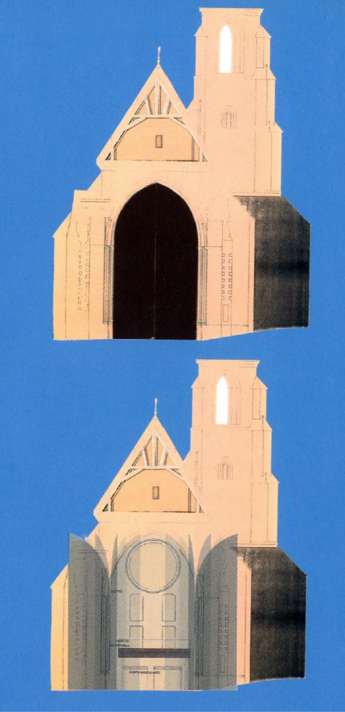
Ref1Eglise Sainte Marie - Jean Nouvel - Sarlat - 2003
A re-enrollment in the present
Idea of reversibility – taking place in a old monument, being able to see the contrast between the old and the new and being able to remove the intervention without altering or damaging the old monument
→ Keeping safe the meaning of the ruins
→ Giving power and rationality to an intervention through the respect of the ruining state of the building
→ Thinking of an inovative way to build without more damaging the site
→ Thinking of the role of the ruins in a city, giving back an importance to those abandoned sites

Ref2Neues Museum - David Chipperfield Architects - Berlin - 1993
→ Reinterpretating of the interior court, cohabiting with the existing
→ Creating an ensemble with the floor work
→ Taking on board the building history without exhibiting it



D1Bi-material New to Old detail
I wanted to do a detail ‘new to old’ which damage the least possible the walls, to respect the site and to try to make the intervention reversible. This idea with the timber beams could be easily removable and is adjustable to reinforce the structure and let the walls intact.
A thin part of the steel goes inside the wall and creates an interlocking link. It can be inserted between two stones or two briks, and could be removed and the hole filled up again. Two timber beams would be fixed to the steal element and would then rest on a carrier element and be able to carry a light floor
Ref3Home Renovation on Sant Frencesc Street (1701) - HArquitectes - Barcelona, Spain - 2017.19


D2Mono-material New to Old detail
Also, I had the idea of giving power to this old concrete by contrasting it with another concrete or another material by contrasting their colour.
The old ruined and damaged wall would be unchaged if it had been expertised that it was still able to support. The first detail would need a level off with concrete on which a steal beam would rest on. Then we could build the rest of the wall with different materials (brick, concrete, rammed earth, etc.). On the second one, no level off would be needed, so we could observe the exact limit of time between the ruin process and the intervention with the physical limit drawn by the juxtaposition of the two colours of materials. It would possibly need an iron framework which I have slightly mentionned in the drawing.


